Tuesday, November 01, 2011

Iowa: Time to rock out with your caucus out!

One aspect of American politics I do not understand is the primaries and intra-party elections prior to the presidential election. In particular, I do not understand why Iowa has the title of being the graveyard of political ambitions by holding the esteemed round one in the presidential race. CNN tried to explain it to me why Iowa always goes first - but it still does not make sense. Not that I have anything against Iowans - in fact, Des Moines is on my bucket list (purely because of its name and nothing else). 
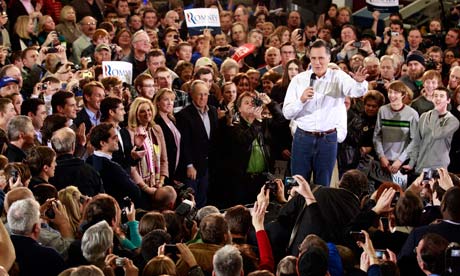
Moving from the geographical aspects of the Republican campaign to the actual candidates lined up, it is despairing to see how battle-tired the American people are and how uninspiring their leaders on both sides  look.  The Republican candidacy has been tainted by Charlatans and controversial characters that try to emulate but somehow lack the charismatic roles of Reagan or even Obama (yes, Obama). Two potentials stand-out though - Romney and Santorum. While Mitt may have been down the pecking order in the 2008 campaign, he is the only one bar Santorum who has not been riddled by scandals, outlandish comments and other politically suicidal moves that other Republicans have made in the past year. 

I do not know much about Santorum, but from the little that I have seen, I am reasonably impressed. Although Santorum is a little too ideological in some respects, he and Romney seem the most reasonable and trustworthy out of the whole bunch. Both he and Romney seem like decent hard-working guys that the American public is yearning for as their leaders. They are not uber-macho men like Perry or riding on the coat-tails of Reaganomics (which worked in the 80's and not now). 

I would be happy to see a Romney Santorum ticket in this year's elections. 

Moving to a bluer shade - Obama is in trouble in the months ahead. He set the bar so high in his 2008 campaign that he was bound to fail in delivering his promises. His re-election campaign will ride on the laurels of inspiring his waves of formerly loyal 2008 voters but his pizzazz will not get him through alone this time. He needs a game changer if he wants to keep the White House. That game changer is Hillary. Already posed to move out of politics to positions like "President of the World Bank", Barak should re-assess his key piece in the Democrat arsenal. Hillary, liked or not, is respected by both aisles and has the credibility to carry Obama on her back to reach a second term. Without her, Obama will lack that anchor which is crucial in the mid-western states.  Of course, Joe Biden does have the experience, but he is rather stale in wooing potential voters.

Americans are tired of wild card candidates. The Tea Party and Occupy movements, as popular as they both may be, are too far right and left of the political spectrum for actual progress in America. The nation needs pragmatic and experienced leaders. This does not mean grey-haired passed-their-sell-by date Washington politicians. Rather, the presidential ticket needs a little grey hair, innovation and flexibility.  Although not the most inspiring bunch, a show-down between Obama/Clinton and Romney/Santorum will be a respectable fight for the 2012 elections. 

Then again, understanding US politics and who will run is as complicated as understanding why little Iowa, a state where hogs outnumber people 5 to 1, is the opening act for what will be a great show. Rock on, Iowa! 

7 Billion is Not Just a Number

31 October 2011, the day the world population hit 7 billion.

In a flash of a generation, our world has harboured an extra billion people. Books from twenty years ago, giving population estimates, Africa 500 million, India 800 million are now outdated. (Mind you, so are books outdated as well.)

This is not a birthday or milestone to celebrate. With the world hitting maximum capacity, this century will be defined by tugging and pulling for resources, which will become scarcer and scarcer, leading to more conflict.

How did we hit this red line? Is it a rise in population growth through longer life expectancies? Is it increased birth rates? It is a mixture of everything, but the cause of sharp increase lies in the hands of growing countries like China and India. The western world's population, all things relative, has hardly grown. Of the billion people added to our planet in the past twenty years, Europe had an meager increase of only 1% to this billion figure.


India and China are the main population centres of the world today. In fact, the most common looking human being is a 28 year old Han (Chinese ethnicity) male. There are 9 million people who match that  exact profile.

An almost instinctive reaction to this demographic threat is to encourage forced population control as they partially do in China, stop large families, tax breaks for smaller ones and so on. While this may sound enticing, it is not going to solve our resources problem. The developing world is not to blame for our increasingly rationed resources. Consumers in America and Europe can waste up to a 100kg of food per person per year. In Africa, that figure is 6 to 11 kgs per year.

The real menace to our future is a growing population in the east coupled with an increasing universal standard of living. What will happen when the Chinese find western tastes of having massive cruise liner holidays, with dozens of ships leaving from Macau a day, wasting tons of everything from smoked salmon to watermelons?


This 7 billion mark is astounding but also may trigger new innovations. Perhaps it will force an industrial renaissance of re-usable energy and create streamlined efficiencies in the way we consume goods. Or maybe, the exact opposite will occur. A global village, where overcrowding will lead to pushing and shoving, will become a far more fragmented place, with each clan scrounging for its own food security and general stability.  Our environment could react to us as a hostile alien where pandemics will be the only way to bring back an environmental equilibrium. We have seen this with avian and swine flu already in the past few years. What's not to say that this is just the start.


Sunday, September 04, 2011

Hipster Revolutions

So Kaddafi is hiding somewhere in a ditch,like his long-time associate Sadam. There is no counter-attack or great beckoning to a people's army to crush the rebels. Face-it Kaddafi - it's over.
In a month or two from now, you will stand trial before a people's court, and expectedly you will shout at the judge and make theatrical rendition of an Islamic Braveheart to a half-amused audience. Your prison sentence or even execution will make your friends in Damascus have even further sleepless nights. You will claim to be a martyr, but no-one will heed your call. Your legacy of 40 years of building a nation will be matched by 40 years of embarrassment for your children's children.  
At this juncture in this so-called Arab spring, it's an apt time to consider what life will be like after Kaddafi goes. But before doing that, it's even more important to understand why Kaddafi left in the first place. The answer to that has two secret ingredients: Obama and economics. 
Barak Obama's famous Cairo speech in June 2009 was a symbolic milestone and prelude to this Arab discontent. Although he said "no single speech can eradicate years of mistrust, nor can I answer in the time that I have all the complex questions that brought us to this point", his words sure planted the seeds of discontent in the populous. Think about it. He arrived in the middle east's largest nation to announce to the world a new order of Arab relations, taking an occasional jab at dictators opposed to democratic reforms. Love it or hate it, Mubarak no doubt felt the personal pinch of that speech.
Sprinkle a little bit of economic collapse with  contempt for relic regimes from the 20th century and vuala! you have a revolution. 
The hipster of this revolution was Tunisia. One forgets that the rioting in Tunisia kicked off over the exorbitant price of food. It's always the case. People get ticked off when the "rent is too darn high".   This was exacerbated by the famous incident of a man committing suicide in the street after his licence for his small vending cart was revoked by corrupt officials. A few weeks later, the leader of Tunisia was out. Then Egypt. Then Yemen. Then Libya, Syria and perhaps even the rest of the gang. 
We have seen this all before. In fact, the Arab spring is a play on words from the Prague spring in the eastern bloc countries. So if we have seen this all before, then where is it heading? 
This is where America can come full circle and step in. Obama supported democratic reforms in the middle east in his famous Cairo speech but now with a political vacuum in that region, proper democracy must come into play. The US must support moderate leaders behind the scenes to be the voice of the discontent that ignited the revolutions.
The era of despotic rule is so 1990's and Kaddafi, Mubarak and friends are relics of that time. What is needed now is reasonable and pragmatic leaders. The last thing we need is charismatic, strong or military-backed leaders to step up to the plate as was the case in the 1950's and 60's. 
Obama has taken a back seat in his countries' involvement in the NATO strikes on Libya but now the moment is ripe for him to encourage stable elections. America has to shake-off its fear of the words "regime change" (and all that it implies). If it fails to get involved as the dominant nation in shaping democracy in the region, then other players will step in and we will go back to the 20th centuries' retro-dictators. And I mean that not in a hipster way. 

Malema and Other Tokoloshes

Julius Malema is facing, yet again, another disciplinary hearing for being out of line with the ruling party. This follows a comment he made several months back calling for regime change in the most ruthless and violent country in Africa: Botswana?
Luthuli House was sieged by hundreds of supporters of Malema, showing their  support by stoning police and journalists (agents of the regime). The riots reached a pinnacle when Malema actually had  to come out to encourage the crowd to save its energy for other battles and not to attack photographers. The hearings have moved to a undisclosed location to stem the bottle-neck of activity surrounding Luthuli House.
Malema's hearing makes me wonder. He is no doubt an instigator and encourages controversial ideas. From shooting boers to overthrowing Zuma, Malema's mere presence in South Africa has many grey-haired folks worried. But is he really a huge threat?
South Africa thrives on the idea of a boogeyman. Whether it is an imperialist, a scarlet pimpernel or a "swart gevaar", all cultures within our nation need a nemesis - a galvanizing force if you will. Sometimes this threat is real but most of the times it is based on an irrational fear.
This is entrenched in our national identity. The threat of the English taking over the Cape created enough hysteria for Afrikaners to pack-up and head up north. The threat of Mandela, the scarlet pimpernel, coming out of jail caused enough South Africans to pack-up and head for Perth. Not even 5 years ago, the threat of Zuma's charisma was seen as the downfall old school Xhosa nostra ruling elite. South Africans like fear. We thrive on it even if it is to our own detriment.
Malema is not a great leader. Charismatic and popular? Yes. A threat? Perhaps. But importantly, he is more a symbol of an idea than an actual person. No doubt he has support and will get only stronger. He may even become President one day long in the future. Perhaps though, we make him out to be larger than what he really is. Even if we were to sell Malema to the Chinese or get rid of him some how, we would soon find another boogeyman to be scared of. It's our national character, it's who we are, regardless of skin colour.